Red Cross taonga find forever home in Te Papa
12 October 2026
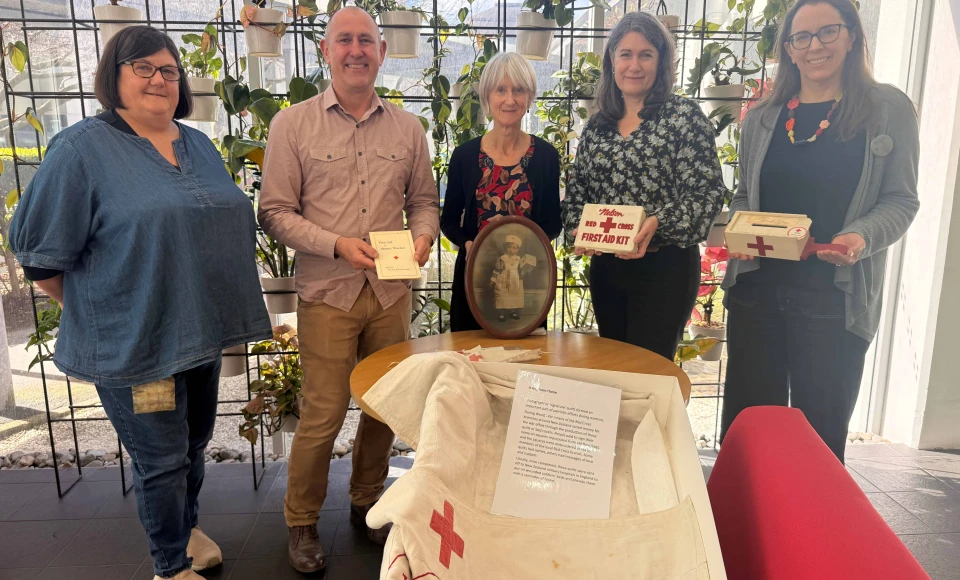
A collection of treasured items telling part of New Zealand Red Cross’ history has found a permanent home at Te Papa Tongarewa | Museum of New Zealand, where they will be cared for and preserved for generations to come.
“We have an extensive archive of really interesting items of historical significance, both to the Red Cross and to New Zealand,” says Secretary General Sarah Stuart-Black. “But we don’t have the high quality, technical capabilities, like climate-controlled rooms, to protect these really fragile taonga.”
One of these items is a pamphlet produced by the New Zealand Red Cross in the late 1940s entitled First Aid in Atomic Warfare – it's believed to be the only one still in existence.
At the end of WWII, in the wake of the first and only use of nuclear weapons, when the United States bombed Hiroshima and Nagasaki in 1945 and the subsequent Cold War nuclear arms race where the Pacific became a major nuclear testing ground, with over 300 nuclear weapons detonated by the US, UK and France, fear of nuclear weapons was all pervasive.
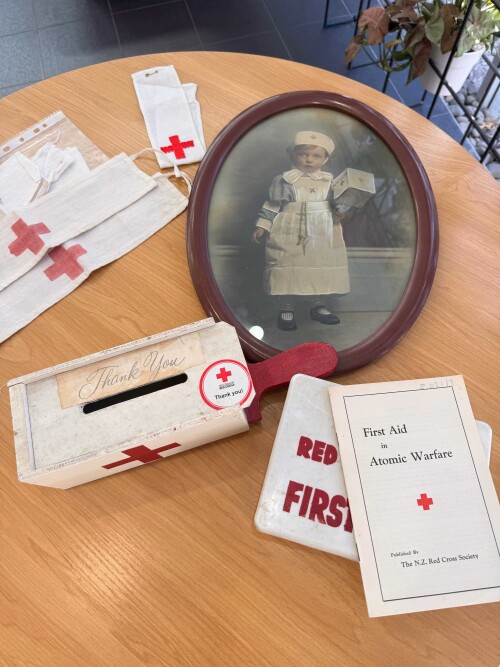
Several Red Cross items | taonga have found a new home in Te Papa Tongarewa | Museum of New Zealand, where they will be cared for and preserved for generations to come.
Alongside the International Committee of the Red Cross (ICRC) appealing to states to ban nuclear weapons, New Zealand Red Cross produced the pamphlet that drew on the known effects from Hiroshima and Nagasaki.
It is a regrettable fact that it has become necessary to face this problem realistically and it is wiser to foresee dangers which may never occur than to find that we are helpless and ignorant in the midst of great disaster surrounded by devastation, burned and injured victims. – First Aid in Atomic Warfare – Introduction
The pamphlet describes the types of injuries that occurred because of what people were wearing – Light coloured clothes afforded more protection than dark clothes – and what to do in the event of an attack – Turn your back to the light, throw yourself on the ground, protect your eyes, head and arms.
In conclusion, it should be clearly understood that this small Booklet is to supply sufficient knowledge to First Aid personnel to give them an outline of what the atom bomb is and what to expect should this country ever be subject to such dastardly action. – First Aid in Atomic Warfare – Conclusion
Agreement to maintain, store and conserve
The pamphlet was one of nine items held by Red Cross in its Wellington head office that have been acquired by Te Papa, following a formal agreement between Red Cross and the country’s national museum to maintain, store and conserve these items.
Alongside the nuclear first aid pamphlet, the items chosen by Te Papa include a wooden collecting box, a signature quilt from 1915 embroidered by members of the Greenhithe community in Auckland for the hospital ship HMNZ HS Marama, a framed photograph of young Wellington toddler, Joan Wyatt, dressed in a Red Cross uniform holding a collection box, one of the original first aid kits the was made available widely for first aid training and several handmade armbands embroidered with the red cross emblem that were worn by nurses, soldiers, cadets and volunteers.
Time for important conversations
Ms Stuart-Black says the acquisition is really the start of some important conversations that need to start happening.
“Across the country we have historically important items, both to New Zealand and the Red Cross globally. We need to ask how these items need to be held for future generations.”
She says it’s a good time to for all Red Cross people to start moving to preserve objects. “Write down those histories, put a story to an item so that it won’t be forgotten.”
New Zealand Red Cross is also in talks with Archives New Zealand to identify and catalogue other items, and discussions are underway with International Federation of Red Cross and Red Crescent Societies (IFRC) alumni to store and display some objects in its Geneva headquarters.
“The fact the IFRC want key pieces from the National Societies to be held and displayed in Geneva is really special,” says Ms Stuart-Black.
For more information
- Find out more about international humanitarian law and how these rules apply to armed conflicts.
International humanitarian law - Learn more about what we do in New Zealand.
Our work in New Zealand - Find out more about ICRC’s work to end nuclear weapons.
ICRC and nuclear weapons - In times of disasters, conflict, and other emergencies, we respond to the needs of vulnerable people around the world.
What we do overseas - Find out more about our Fundamental Principles and how they guide our work.
Our Fundamental Principles - Find out more about the International Red Cross and Red Crescent Movement.
Our Movement
Header Image: (From left) Stephanie Gibson, Curator, NZ Histories and Cultures, Te Papa Tongarewa | Museum of New Zealand, Sean Stewart GM Operations, Carolyn McGill, Collection Manager Humanities,Te Papa Tongarewa | Museum of New Zealand, Sarah (Norm) Stuart-Black, Secretary General, and Angela Buchholz Management Support, Office of the Secretary General with Red Cross taonga.