Waiheke community folds hope into paper cranes
18 August 2026
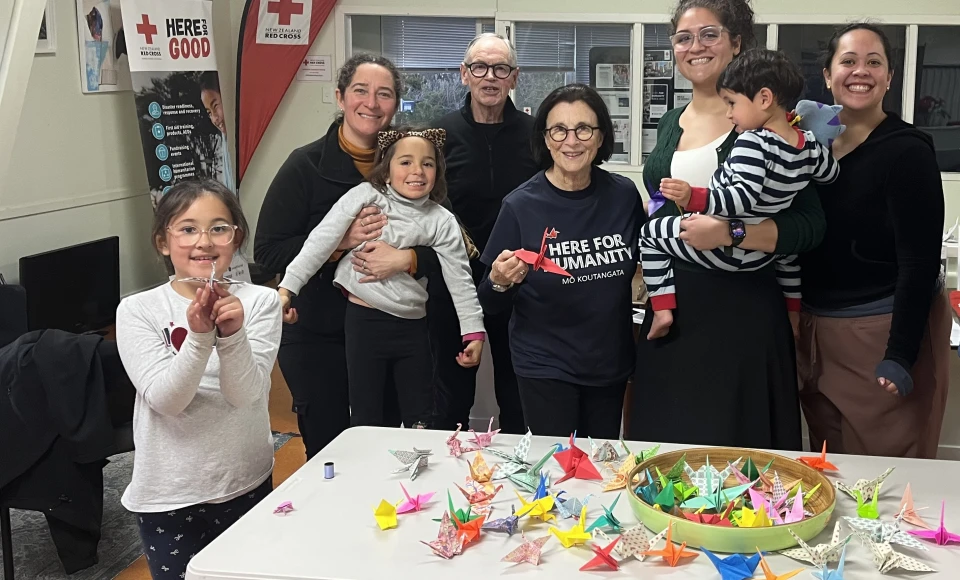
To commemorate the 81st anniversary of the nuclear bombing of Hiroshima and Nagasaki earlier this month, Waiheke Red Cross hosted its second Paper Cranes for Peace event.
Waiheke branch president Jill Caughley said they had a great turnout of people who came to make cranes, including a six-year-old who said she remembered the afternoon as one of ‘peace and hope’.
On 6 August 1945, an atomic bomb devastated the Japanese city of Hiroshima, killing around 70,000 people. Just three days later, a second atomic bomb struck Nagasaki, causing the deaths of a further 39,000 people. By 1950, an estimated 340,000 people had died as a result of the bombs and their lasting effects.
Cranes for Peace
The Cranes for Peace event started with a karakia for peace and a retelling of the origin story of the event of Sadako Sasaki, who survived the atomic bombing of Hiroshima, but went on to need treatment for leukaemia a decade later.
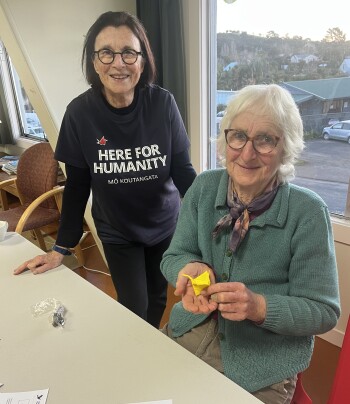
Waiheke branch president Jill Caughley and volunteer crane maker Dorothy
In August 1955, Sasaki shared a hospital room with an older girl, whose classmates had sent her origami paper cranes the traditional Japanese equivalent of a get-well card. Sasaki's father told her of the legend that folding 1000 paper cranes would earn the folder a wish. Sasaki set a goal to fold 1000 cranes and used any scrap of paper she could find from medical packaging to wrapping paper gifted by other patients from presents sent by friends and family.
By the time she died in October 1955, Sasaki had made 1300 paper cranes.
Jill says Sasaki didn't intend the wish for herself. Rather that she was worried about the terrible implications of the weapon that had so affected her country and her life. "She wished for peace," says Jill. "On every crane she put 'I write peace on your wings and you will fly all over the world.'"
Every year on the anniversary of the Hiroshima bomb, people around the world fold origami cranes to symbolically bolster that shared wish for peace.
“Folding paper cranes and telling Sadako's story is a gentle and compassionate way of presenting a complex and disturbing topic,” says Jill.
Movement calls for nuclear weapon prohibition
More than eight decades later, there are still more than 13,000 nuclear weapons in the world. The Movement continues to call for nuclear weapons never to be used again, and for their complete prohibition and elimination.
At the Waiheke event, branch members also had information displays about the International Red Cross' work towards nuclear disarmament, humanitarian efforts and how to help.
Find out more
- Find out more about international humanitarian law and how these rules apply to armed conflicts.
International humanitarian law - Learn more about what we do in New Zealand.
Our work in New Zealand - Find out more about ICRC’s work to end nuclear weapons.
ICRC and nuclear weapons - In times of disasters, conflict, and other emergencies, we respond to the needs of vulnerable people around the world.
What we do overseas - Find out more about our Fundamental Principles and how they guide our work.
Our Fundamental Principles - Find out more about the International Red Cross and Red Crescent Movement.
Our Movement
Header image: A group of people attended an event to make paper cranes to commemorate the 81st anniversary of the nuclear bombing of Hiroshima and Nagaski hosted by the Waiheke Red Cross.