
Competition brings International Criminal Court experience to New Zealand
5 December 2025
On Saturday 29 November, teams converged on Victoria University of Wellington to compete in our annual international humanitarian law Moot Court competition.
Humanitarian law — also known as the rules of war — applies to armed conflicts. Humanitarian law protects people who aren’t directly involved in armed conflict and restricts what those involved can do.
Six teams representing New Zealand’s law schools took part in the competition:
Ōtākou Whakaihu Waka | University of Otago
- Emelia Gomes
- Isabella Johnson
Te Herenga Waka | Victoria University of Wellington
- Emily McKechnie
- Edward Nelson
- Sam Withers
Te Wānanga Aronui o Tāmaki Makau Rau | Auckland University of Technology (AUT)
- Jazz Chhatwal
- Noah Simunac
- Tremayne Thompson
Te Whare Wānanga o Waikato | University of Waikato
- Kayla Chapman
- Salem Murray
- Liam Shelley
Te Whare Wānanga o Waitaha | University of Canterbury
- Phoebe Donald
- Matt Fraser
- Elliot Molloy
Waipapa Taumata Rau | University of Auckland
- Hayley Brown
- Inaayat Chatha
- Ben Jones
This year’s fictional case saw Manustan President Zara Smith — a former human rights lawyer — appear before the International Criminal court on charges of war crimes relating to torture and murder. Though it wasn’t a real case, it highlights real concerns of violence between ethnic groups, historical trauma from conflict, and armed civil violence.

Participants, judges, and New Zealand Red Cross representatives gather for a group photo following the Annual Moot Court Competition 2025.
The competition began with two preliminary rounds in which each team argued as both the defence and prosecution before two teams progressed to the final. Teams presented their arguments to a fictional International Criminal Court comprised of real legal experts.
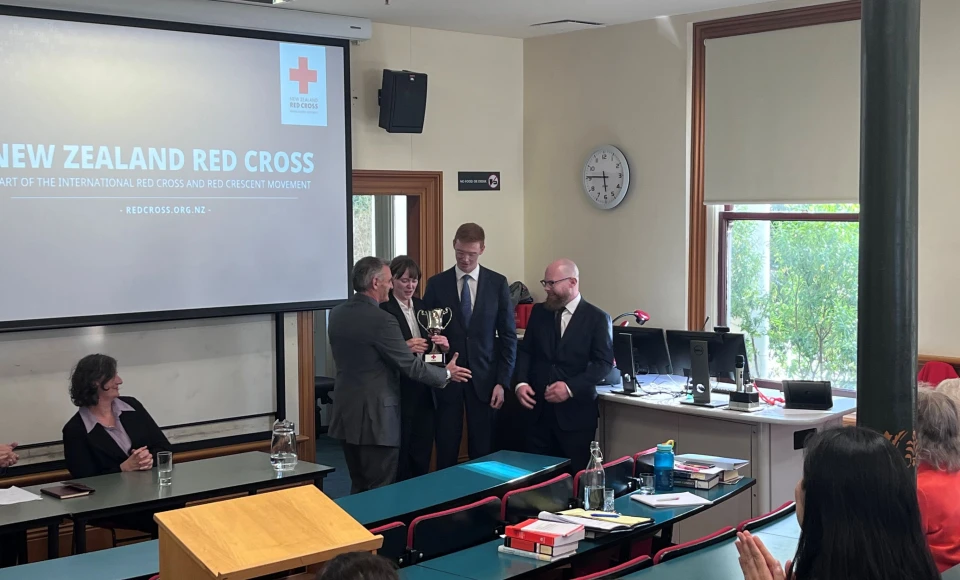
The final was close, and the judges ultimately declared Victoria University of Wellingtonn — arguing the prosecution — winner, with the University of Auckland — arguing the defence — coming in second. Edward Nelson (Faculty of Law) was awarded best speaker the Red Cross Moot Court competition in Wellington.
Emily McKechnie and Edward Nelson will represent New Zealand at the Red Cross Asia Pacific Humanitarian Law Mooting Competition in Hong Kong in March 2026, organised by International Committee of the Red Cross (ICRC).
“The Moot Court is all about enhancing knowledge and understanding of humanitarian law within New Zealand,” said Dr Murdoch Stephens, our Principal Advisor – International Humanitarian Law and Policy.
“For humanitarian law to be useful in times of conflict, we need to understand it during times of peace. We promote learning in New Zealand as well as how people can put it into practice. This way, during armed conflict the impact on people is limited and violations are prevented.”
We hold the competition every year and it's open to teams from each of the six New Zealand universities' law schools. We’re grateful to the students, coaches, and supporters — especially ICRC and the Embassy of Switzerland in New Zealand — who make the competition possible.
People who volunteered their time as judges:
- John Adank
- Hannah Crothers
- Judge Bill Hastings
- Zoe McCoy
- Commander Prema McIntosh
- Christine Nam
- Hannah Reid
- Judge Kevin Riordan
- Leishia Pettigrew
- Commander Jonathan Rowe
More information
Find out more about our Moot Court competition and its aims.
Find out more about international humanitarian law and how these rules apply to armed conflicts.
International humanitarian law
Learn more about what we do in New Zealand.
In times of disasters, conflict, and other emergencies, we respond to the needs of vulnerable people around the world.
Lead image: New Zealand Red Cross National President John Dyer presents this year’s trophy to the Victoria University of Wellington moot team, Emily McKenchnie, Edward Nelson, and Sam Withers.