
No nukes – 80 years of advocating for humanity
26 September 2025
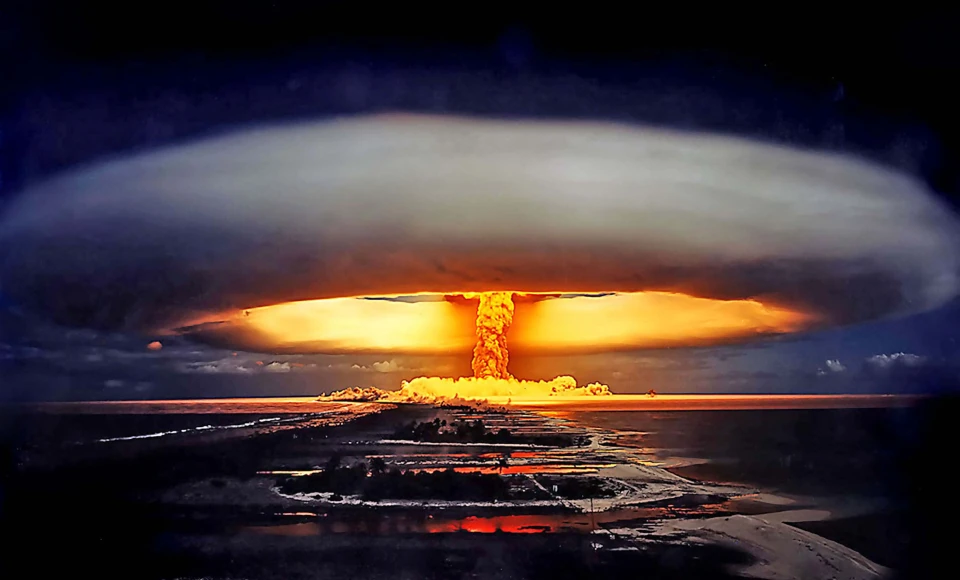
This year marks 80 years since nuclear weapons were used in the Japanese cities Hiroshima and Nagasaki. In the decades since, people from across the world — as well as our international Red Cross and Red Crescent Movement — have organised in opposition to the indiscriminate and immensely destructive force of these weapons.
To this day, no city can prepare for nuclear weapons, and no nation can effectively respond to them. Countless people would be killed and injured if one of the more than 13,000 nuclear weapons around the world was detonated.
Hiroshima and Nagasaki
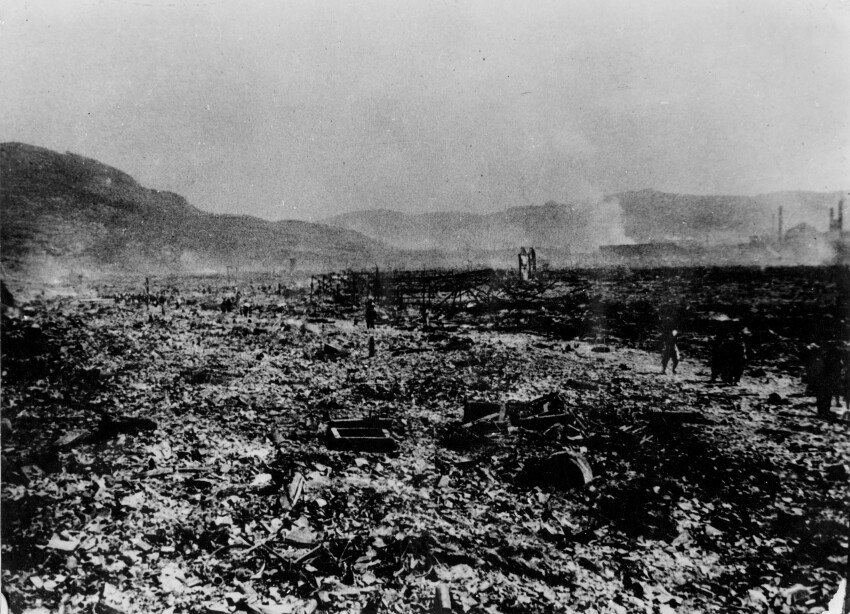
Hiroshima, 1945.
On 6 and 9 August 1945, the United States detonated nuclear weapons over Hiroshima and then Nagasaki, killing more than 240,000 people. Japanese Red Cross were among the first at the scene in both cities where they worked in near-impossible conditions to help the wounded and sick.
Frans Bilfinger was the first International Committee of the Red Cross (ICRC) representative to reach Hiroshima, “the centre of the city was sort of a white patch, flattened and smooth like the palm of a hand.”
“Nothing remained. The slightest trace of houses seemed to have disappeared.”
That same year, ICRC appealed to states to ban nuclear weapons. Today, 80 years on, our colleagues in Japanese Red Cross Hospitals continue to treat people whose health conditions are related to radiation exposure.
Nuclear testing in the Pacific
From 1946 to 1996, more than 300 nuclear weapons were tested in the Pacific by France, the United Kingdom, and the United States. Other weapons were also tested, including hydrogen explosives and ballistic missiles.
The impact was devastating.
‘Chains’, released in 1996 by New Zealand musicians DLT and Che Fu.
Come test me like a bomb straight from Mururoa
How comes i got cyclops fish in my water
A nation of Pacific lambs to the slaughter
Three eyes for my son and an extra foot for my daughter
Gifts from a land that I don't even know
I was too slow, to even see that escargot
You say I'm all blow no cash exchange I didn't lie
There's a picture of me in the dictionary under "French
Fry", no racism I'm out for who's in charge
I'd like to lay a fat cable in their backyard
Too far they've gone now I'm radioactive strong
I just walk past the switch and all the lights turn on
No "last dragon" just left my bones exposed
Didn't reach no final level yet my body still glows
Why do you wanna annoy, nuclear boy with your toy
Wa Pihia neke mase a koe
Feel the light of one who stays over come some
Day set your sights and chip away
Come break my chains come help me out living in
The city ain't so bad (x4)
Ch-ch Chale may i pull you 'side for a second
Asking you a question checkin what you reckon
Why you letting your guard down with a frown
Freaking bout what you wear how you walk
Around town did your heads ever think further
Than threads, instead your dress code of the
Soul wardrobe is dead, mislead maybe why's my mirror hazy, morphin into something else my own imae is fading, making, moulding, holding, folding, is it more or a moive, Channel 2 or 3? Stolen stupid as such why is it televsion be now ruled by a crutch, hairless and fearless
Devoid of all shape like a snake, stick, your mouth around the bit that says inflate, breath deep if a sucker that you be, time is running out for me, to old for cold rubber making whoopee, i prefer a woman who is real to the touch, she feels much, she be the "starsky" to my hutch
You crunched up my sisters to the point of no
Return, anoint the tan with the ointment, now
Ken & barbie burn, crispy pink, with a plastic
Sheen turn it over, baste it with a bit of margerine
"mmm mmm smells good" the swine taste fine whe're my christmas pud
Come break, my chains come help me out living in the city ain't so bad
Come break, my chains come help me out living in the city ain't so bad
Come break, my chains come help me out living in the city ain't so bad
Come break, my chains come help me out living in the city ain't so bad
I opened up my mind, i severed it straight down
The middle, conciousness like the ocean started
Out from the trickle, inspiration now the damn is
Broken my brain is open game is over time to
Insert your token, hopin i didn't see my deepest
Upleasentries my creepy crawlies goupe title
"insecurities" what-chu-mean? i mean the kind
That make you worry, buggers like bove and
Money ain't it funny regardless of emotions
That i've found the things that pick you up can
Be the same that put you down, underground in
The pits of dispair way down there, once again
I've got to make my way from here, bleeding
Needing a piece of self discovery so i can
Patch myself up and make a quick recovery
Cause it just soon helium baloon bursting
Come break, my chains come help me out living in the city ain't so bad
Come break, my chains come help me out living in the city ain't so bad
Come break, my chains come help me out living in the city ain't so bad
Come break, my chains come help me out living in the city ain't so bad
Come break, my chains come help me (Tights is the gag in my mouth)
Come break, my chains come help me (Tights is the gag in my mouth)
Come break my chains come help me out (picking up the reigns in the south)
Tell who's gonna buy who's gonna sell?
People were forced from their ancestral homes to make way for nuclear testing, or because the effects of explosions and radiation made staying impossible.
“When we decided to leave Rongelap Atoll, the old people cried to leave their homeland. But I said, ‘What about your grandchildren? Do you want them to die?’”, said Senator Jeton Anjain.
Thousands of people were affected by thyroid, throat, and lung cancers, as well as leukaemia, lymphoma, and muscular skeletal conditions associated with nuclear radiation exposure. Pacific nuclear testing killed thousands of animals and destroyed ecosystems. Ancestral homes used as test sites continue to be dangerous to life and some show signs of leaching radioactive material into the ocean.
Opposition in the Pacific to nuclear testing and weapons was tied to movements centred around decolonisation and indigenous sovereignty. Nuclear Free and Independent Pacific formed after their first conference in Fiji in 1975. They organised with indigenous peoples from across the Pacific and Aisa who were affected by nuclear weapons testing and the ongoing effects of colonisation.
They adopted the People’s Charter for a Nuclear Free and Independent Pacific at their 1983 conference in Vanuatu:
“Our environment continues to be despoiled by foreign powers developing nuclear weapons for a strategy of warfare that has no winners, no liberators, and imperils the survival of all humankind.”
Palau passed legislation making the island nation nuclear free in 1979. They were followed by Vanuatu in 1982 and the Solomon Islands in 1983. In 1985, the South Pacific Nuclear Free Zone Treaty was signed by:
- Australia
- Cook Islands
- Fiji
- Kiribati
- Nauru
- New Zealand
- Niue
- Papua New Guinea
- Samoa
- Solomon Islands
- Tonga
- Tuvalu, and
- Vanuatu.
The treaty prohibits:
- Manufacturing, stationing, or testing nuclear weapons within the signatory states.
- Using nuclear weapons against parties to the treaty.
- Any nuclear testing within the zone.
In 1996, France and the United Kingdom signed and ratified the treaty. The United States also signed that year but hasn’t ratified it.
Nuclear free New Zealand
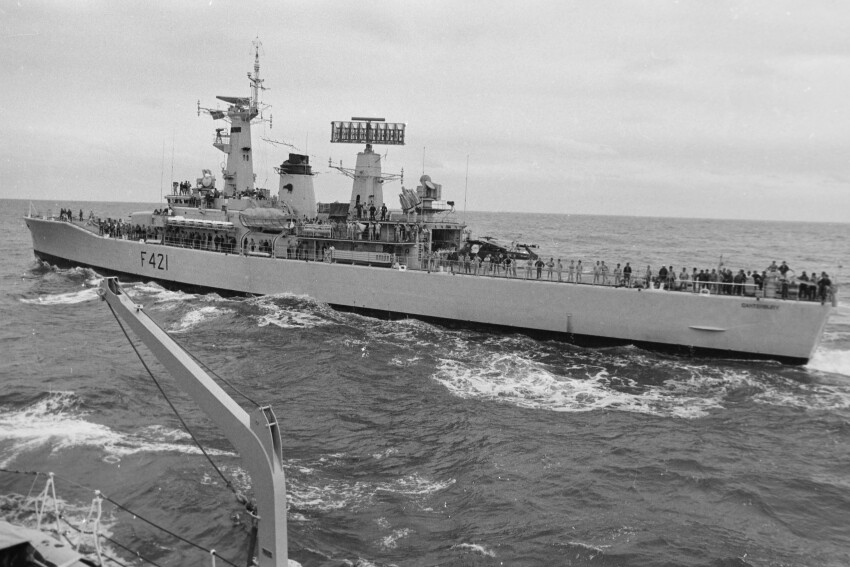
HMNZS Canterbury viewed from HMNZS Otago protesting French atmospheric nuclear testing at Mururoa Atoll, 1973. Courtesy of the Air Force Museum of New Zealand.
New Zealand supported the first resolution of the first United Nations General Assembly in 1946 to ban nuclear weapons. From 1966, the New Zealand government protested both nuclear testing and nuclear presence in the Pacific.
Mururoa Atoll was a focal point for nuclear testing and opposition. In May 1973, the New Zealand and Australian governments took France to the International Court of Justice to ban nuclear tests.
In June that same year, Cabinet Minister Fraser Colman sailed with HMNZS Otago and HMNZS Canterbury to Mururoa to protest Franch nuclear testing. After Colman and the ships’ crews observed two atmospheric tests, the French government moved testing underground in 1974, but didn’t stop until 1996.
Visits from American warships to New Zealand territories saw protests both on and off the water. In February 1985, the New Zealand government refused entry to the USS Buchanan because the United States wouldn’t confirm or deny if any of their ships had nuclear capability.
In July that same year, Greenpeace’s anti-nuclear ship Rainbow Warrior suffered extensive damage in Auckland harbour after French agents attached mines to its hull. The explosion from the first mine heavily damaged the ship, while the second killed photographer Fernando Pereira.
The sinking of the Rainbow Warrior horrified the New Zealand public and contributed to a groundswell of opposition to nuclear prescence in the Pacific. In 1987, the New Zealand Nuclear Free Zone, Disarmament, and Arms Control Act was passed. It established New Zealand as a nuclear and biological weapon-free zone.
Treaty on the Prohibition of Nuclear Weapons
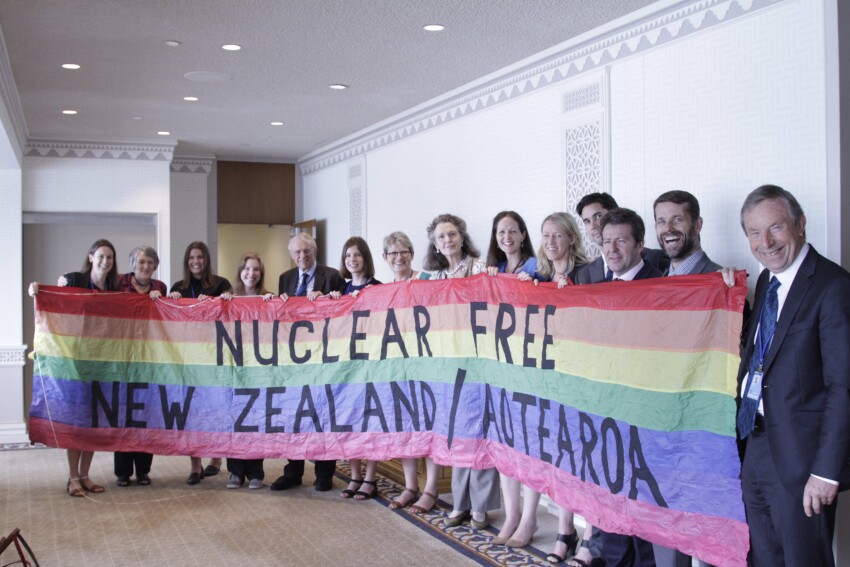
New Zealand representatives at disarmament conference in Mexico, 2017. Courtesy of the United Nations Association of New Zealand.
Since 1945, the international Red Cross Red Crescent Movement has advocated for nuclear weapons to be banned. ICRC has made their position clear over 80 years – that nuclear weapons are one of the most abhorrent and inhumane types of weapons ever created.
The history of opposition to nuclear weapons shows that the defining value of humanity, by uniting people globally and working together, can be upheld and defended for future generations.
In 1996, the International Court of Justice stated that using nuclear weapons would breach international humanitarian law. One of the core rules of humanitarian law is that sides must distinguish between civilians and the military – which simply isn’t possible with nuclear weapons.
The Court also declared that states are obliged to work towards nuclear disarmament. The Comprehensive Nuclear Test Ban Treaty was adopted by the United Nations General Assembly in September that same year, which bans testing nuclear weapons testing.
In 2010, ICRC called for nuclear weapons to be prohibited and eliminated for good through a binding international treaty. In November 2011, our Movement adopted a resolution supporting the elimination of nuclear weapons. This was the basis of our ‘make nuclear weapons the target’ campaign, which was run by ICRC, our sister societies worldwide, and New Zealand Red Cross.
In 2017, the United Nations organised negotiations for a legally binding treaty to prohibit nuclear weapons. The Treaty on the Prohibition of Nuclear Weapons was adopted on 7 July 2017 and came into effect in January 2021.
The treaty recognises the catastrophic consequences of nuclear weapons and prohibits them based on humanitarian law. Alongside ICRC, we made a joint submission to the New Zealand government’s Foreign Affairs, Defence, and Trade Select Committee in 2018 supporting the treaty.
Since 2017, 73 states have ratified the treaty — including New Zealand — and another 25 have signed it. South Africa remains the only country to voluntarily give up all nuclear weapons after developing them, which they did in 1989. The South African government ratified the Treaty on the Prohibition of Nuclear Weapons in 2019.
The treaty marks the beginning of the end to the nuclear age, which we’ll continue to work towards until nuclear weapons are totally eliminated.
Header image: A French nuclear explosive shortly after detonation on Fangatufa Atoll, French Polynesia, 1970.
Find out more
- Find out more about international humanitarian law and how these rules apply to armed conflicts.
International humanitarian law - Learn more about what we do in New Zealand.
Our work in New Zealand - Find out more about ICRC’s work to end nuclear weapons.
ICRC and nuclear weapons - In times of disasters, conflict, and other emergencies, we respond to the needs of vulnerable people around the world.
What we do overseas - Find out more about our Fundamental Principles and how they guide our work.
Our Fundamental Principles - Find out more about the International Red Cross and Red Crescent Movement.
Our Movement