The long road to recovery after multiple disasters in the Philippines
22 December 2025
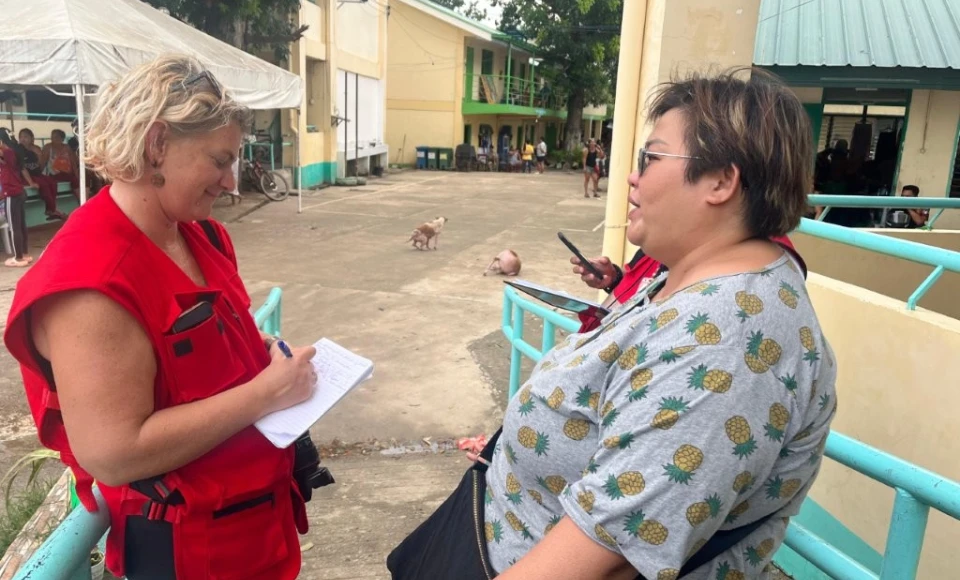
“Don’t forget” is seemingly such a small request. It comes from New Zealand Red Cross international delegate Ellie van Baaren, currently in the Philippines, where three huge disasters have recently ravaged the densely populated country, affecting countless human lives.
“It’s easy to follow the mainstream news cycle, which moves on fast, but the really big stuff starts now,” she explains.
“Building back and recovery – that’s a huge project. It’s not going to be done by Christmas.”
Generous donations to our Global Disaster Fund allowed us to send Ellie to the Philippines for three months at the end of October, in the wake of the powerful Cebu earthquake on 30 September. Within days of her arrival, Typhoon Kalmaegi slammed into the country from 3 to 5 November, swiftly followed by Super Typhoon Fung-Wong on 8 and 9 November.
These back-to-back catastrophes – claiming at least 280 lives (more than 120 people are still missing), displacing 619,000+ people, damaging or destroying 660,000+ homes, and affecting 13.4 million people – have left communities grappling with shortages of shelter, food, and clean water, as well as health crises and trauma amid ongoing aftershocks and further typhoon risks.
Ellie leads communications for the International Federation of Red Cross and Red Crescent Societies (IFRC) response, supporting the Philippine Red Cross by coordinating efforts to document and share the voices of affected communities. Based in Manila, she travels to frontline areas to piece together stories that humanise statistics and rally global support.
“It's a conflicting thing, this job. You know you're helping, but at the same time, it feels like a drop in the ocean".
Ellie van Baaren
“You're asking survivors to relive some of the most traumatic experiences of their lives, but most people are incredibly grateful that someone's asked and someone's listening, because they're one in however many thousands who are suffering.
“And the questions I’m asking and the answers they’re giving contribute to the assistance the Red Cross provides and how it’s delivered.”
The scale of destruction and loss
In Cebu City’s remote hills recently, Ellie was struck by the scale of destruction in places still unreachable by heavy machinery. Towering piles of branches, vegetation, and possessions marked where floods had surged over 10-12 metre concrete flood walls, rising to rooftops in minutes and turning familiar, tame rivers into deadly torrents.
Families told her they clung desperately to anything they could. “They were literally holding on to coconut palms just hoping that they held on long enough for the water to recede.”
One survivor at a relief distribution centre had “lost everyone.” “She lost her kids, she lost her husband, she lost her mother.”
A story that stays with Ellie is that of a young Philippine Red Cross volunteer who had been on the job only a month when Typhoon Kalmaegi struck.
“He was driving a Red Cross ambulance to help the injured,” she recalls.
“Meanwhile, his mother was washed away. She was his only family. He lost everything while he was helping other people.”
When she spoke to him a week later, he admitted that while he smiled and joked with other volunteers to lift their spirits, he was privately wrestling with guilt. “He feels like he let his own family down.”
Basic items restore dignity, shelter most urgent need
These devastating encounters contrast sharply with moments of quiet uplift at relief distribution centres, where basic items such as pots, pans, plates, sleeping mats, toilet paper, and toothbrushes elicit pure joy.
“You can hear it in their voices and their smiles are huge. Considering everything they've lost, this is so small, but it means a lot,” Ellie says.
“In a place where it has become difficult to access clean water and safe sanitation facilities, where many homes are mud-caked and uninhabitable, and livelihoods have been wiped out, such small mercies restore a sliver of dignity and normalcy.”
Shelter remains the most pressing need. Many people are still living under tarpaulins or crowded in with extended family because their houses are damaged or unsafe, or they are simply too afraid to return. Riverbank settlements – which were already high-risk – have been obliterated, and it’s not safe for residents to rebuild. But the reality is they have no other place to go.
Schools that have been used as evacuation centres have since reopened for students to avoid further disrupting their education.
“You’ve got situations where the main school gyms or big halls are still packed with displaced families, while kids are back in the classrooms. It’s a tough situation for everyone,” Ellie says.
Resilient volunteers and communities
Amid the archipelago’s vast geography – some 2,000 inhabited islands – the Philippine Red Cross is uniquely positioned with local volunteers in nearly every community, the unsung backbone of the organisation.
Volunteers also staff a 24/7 emergency hotline trusted deeply by locals. Ellie recalls the story of one man stranded on a rooftop who refused government rescuers, insisting on waiting for the Red Cross because he knew that meant safety.
Dedicated Philippine Red Cross teams, supported by international delegates like Ellie and many others, continue to lead relief activities while also planning for the recovery, but sustained global support remains essential.
“What I learn every single time I work in a disaster is how resilient both volunteers and the communities are, and how much they do for each other,” Ellie says.
“It’s bad in the affected areas here, but people are rising again. People are amazing at bouncing back. They just need a bit of support from the global community to keep going and rebuild what’s been broken and remind them they’re not forgotten.”
How New Zealand Red Cross is supporting the response
Ellie’s deployment to the Philippines has been made possible thanks to generous donations to our Global Disaster Fund.
Donations from people like you help to ensure that, through the International Red Cross and Red Crescent Movement, we can deliver vital immediate and long-term humanitarian relief to communities in urgent need – as well as support New Zealand delegates responding to disasters worldwide.
Header image caption: New Zealand Red Cross international delegate Ellie van Baaren, is currently in the Philippines working for the IFRC, where three huge disasters recently ravaged the densely populated country, affecting countless human lives.